Frequently Asked Questions
Have questions? We are here to help.



The money choices you make today can be a gift you pass along to Future You, the person you’ll be five, 10, or even 20 years from now. For example, the interest you can gain on savings and investments you start today could help Future You buy a home, retire comfortably, or fund your children’s education. But just as equally, the interest you pay on any outstanding debt you carry can work against you, too.
Understanding compound interest can help you see how today's small decisions can lead to very different financial outcomes in the future. And you don't need a big salary, a perfect budget, or a finance degree to put this knowledge into action.
We’ve all made money decisions we regret. We’re human, after all. It’s often only in hindsight that we see their true impact, and most of us have wondered what we’d do differently with a second chance. That’s the idea behind Credit Canada’s Future You Money Project, presented by easyfinancial. It’s a new program with a Future You Money workbook, calculators, real Canadian stories, and expert guidance, all designed to help you see life more clearly and make better financial decisions for your future self.
Understanding compound interest is one of the most powerful shifts you can make to build wealth, reduce debt, and give Future You more options. This Financial Literacy Month, let’s use that idea as the spark to take back control of your financial story, starting with how compound interest in Canada really works.
Ready to see where today’s choices could lead? Explore the Future You Money Project and start planning for the life you want.
Compound interest is interest earned on your original savings and on the interest those savings earn. In short, your money can grow faster over time because you earn returns on previous returns.
For example, $1,000 earning 5% annually grows to $1,050 after one year. At this point, compound interest and simple interest are mathematically identical. But the real magic happens in the following year.
In Year 2, instead of earning 5% interest on $1,000, you’re now earning 5% interest on $1,050, which equals $52.50, bringing your total to $1,102.50. That extra $2.50 is the interest earned on interest.
The difference comes down to whether you earn interest on your interest.
With simple interest, you earn interest only on your original deposit. The interest earned doesn't get added to your balance to earn more interest.
With compound interest, you earn interest on both your original deposit and the interest it accumulates. As long as you leave your money in the account, your balance grows and earns even more interest over time.
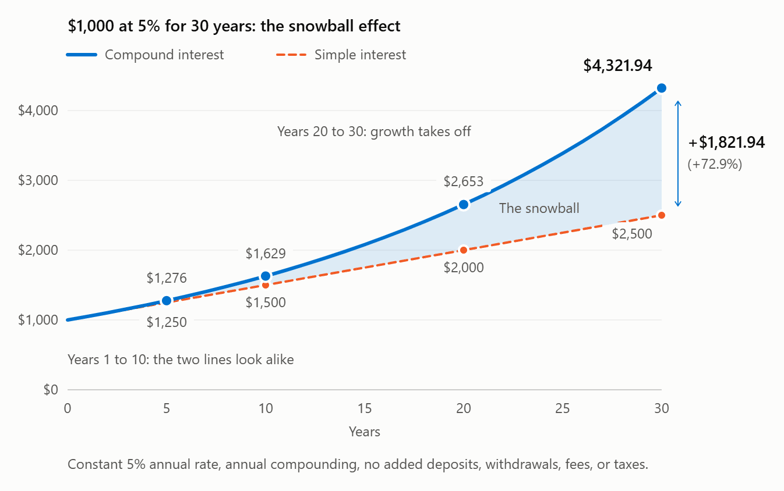
Imagine you put $1,000 into an account earning 5% annually and leave it untouched for 30 years. Here's how your balance would grow under each type of interest:
|
Simple interest |
Compound interest |
Difference |
|
|
Starting deposit |
$1,000 |
$1,000 |
$0 |
|
Annual interest rate |
5% |
5% |
0% |
|
Balance after five years |
$1,250 |
$1,276.28 |
+$26.28 (+2.1%) |
|
Balance after 10 years |
$1,500 |
$1,628.89 |
+$128.89 (+8.6%) |
|
Balance after 20 years |
$2,000 |
$2,653.30 |
+$653.30 (+32.7%) |
|
Balance after 30 years |
$2,500 |
$4,321.94 |
+$1,821.94 (+72.9%) |
Example assumes a constant 5% annual rate, annual compounding, and no additional deposits, withdrawals, fees, or taxes. For simple interest, annual interest is withdrawn rather than reinvested.
The difference may seem small at first, but it becomes much more significant over time. After 30 years, compound interest grows your $1,000 deposit by $1,821.94 more than simple interest, which is almost 73% more, without any additional deposits. That's the power of earning interest on interest.
Money Tip: Give Future You a tax-free advantage
In Canada, interest earned in a regular savings account is generally taxable. A Tax-Free Savings Account (TFSA) offers another way to save and invest. Interest and investment earnings in a TFSA are generally tax-free, allowing your money to grow through compound interest without income tax reducing your returns.
Just remember to stay within your available TFSA contribution room.
Compound growth works a bit like a snowball rolling downhill. As it gathers snow, it gets bigger, and the larger it gets, the more snow it can pick up.
In short, your savings work in a similar way. The interest you earn can generate more interest, which can generate even more earnings over time. This is why compound growth often starts slowly but accelerates as your balance grows.
The longer your money has to compound, the greater its potential to grow. But starting early doesn't mean starting at 20. It means starting today rather than putting it off until tomorrow. Whether you're 20, 40, or 50, making regular contributions and giving your money time to grow can make a meaningful difference.
Four factors influence how much your money can grow:
Quick Tip: The Rule of 72
Want to estimate how long it could take your money to double? Try the Rule of 72. Simply divide 72 by your expected annual interest rate or rate of return.
For example, if your savings earn 6% interest annually, your money could double in approximately 12 years (72 ÷ 6 = 12), assuming the rate stays the same and interest compounds annually.
It's a quick way to see how even a small difference in your interest rate can affect how quickly your money grows.
You don't need to predict the perfect moment to start saving or investing. Starting as soon as you can, contributing regularly, and staying focused on your long-term goals can matter more than waiting until you have a specific amount in your budget.
Compound interest can help you build wealth by allowing savings and investment earnings to grow together over time. The earlier you start, the more time your money has to grow. But you don't need a large amount to get started. Even $50 a month can help you build momentum toward a savings goal.
One way to make saving more consistent is to automate it. Consider setting up a pre-authorized contribution (PAC) through your bank to automatically transfer a manageable amount into a savings or investment account on payday. For example, scheduling a $50 transfer every payday means you're putting money aside before everyday expenses have a chance to eat into it. You won't have to remember to save or make the decision each time.
Start with an amount that fits your budget. Even small, regular contributions can add up over time and give compound interest more money to work with.
Registered accounts can help Canadians grow their money while benefiting from tax advantages. The right option depends on what you're saving for, your income, and your financial circumstances.
|
Account |
What it is |
Best suited for |
How the tax advantages work |
|
A registered account that lets you save or invest money and earn tax-free income. |
Flexible goals for saving or investing |
The money you earn inside the account grows tax-free, and you don't pay taxes when taking money out. Putting money in does not lower your income taxes. |
|
|
A registered account designed to help you save and invest for retirement. |
Saving for retirement |
The money you put in can lower your income taxes for that year. You pay tax when you withdraw the money later. |
|
|
A registered account designed to help eligible first-time homebuyers save for a qualifying home purchase. |
Saving to buy your first home |
The money you put in lowers your income taxes. Taking money out to buy an eligible first home is tax-free. |
Not sure which account to choose? Start with your savings goal:
These accounts aren't mutually exclusive. Depending on your goals, eligibility, and contribution room, you may be able to use more than one.
These accounts also don't guarantee a specific growth rate. How much your money grows depends on what you save or invest in, how much it earns, any fees, and how long you leave it in the account.
For example, inside a TFSA, you can hold cash savings or investments, like Guaranteed Investment Certificates (GICs) and stocks or funds. The tax benefits let your earnings grow without paying taxes on the growth each year.
Keep in mind that investments can lose value, and each account has contribution limits and rules for withdrawals. Check the Canada Revenue Agency's TFSA guidance and official RRSP and FHSA rules before deciding where to save.
Registered accounts can help you make the most of compound interest by allowing your earnings to grow with certain tax advantages. Choosing an account that fits your goals, contributing regularly, and giving your money time to grow can help put Future You in a stronger financial position.
Starting early gives your money more time to compound. Here's an example comparing two people who save different amounts over 30- and 20-year periods.
|
Person A |
Person B |
|
|
Starts saving at age |
25 |
35 |
|
Monthly contribution |
$100 |
$200 |
|
Years contributing |
30 |
20 |
|
Total contributions |
$36,000 |
$48,000 |
|
Total estimated growth (interest earned) |
$47,000 |
$34,000 |
|
Estimated balance at age 55 |
$83,000 |
$82,000 |
Estimates assume a 5% annual return, monthly contributions at the end of each month, and monthly compounding. Figures are rounded and exclude fees, taxes, and investment fluctuations. Actual returns will vary.
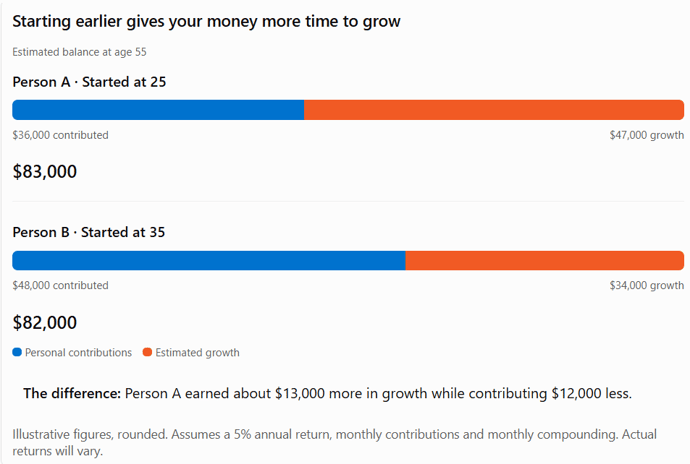
At first glance, the final balances look almost identical. But look at how each person got there. Person A contributed $36,000 and earned approximately $47,000 in interest. Person B contributed $48,000 but earned approximately $34,000 in interest.
That's about $13,000 more in growth for Person A, despite contributing $12,000 less. Starting 10 years earlier gave their money more time to earn returns, and those returns had more time to generate additional growth.
The key takeaway? Starting early can make a meaningful difference, even if you can only save a small amount at first. And if you're starting later, don't let that discourage you. Saving what you can, when you can, still gives your money an opportunity to grow.
Compound interest can work against you when interest charges are added to debt, and you continue carrying a balance. In short, the longer you take to repay high-interest debt, the more interest you may pay overall.
Credit card interest can make an existing balance more expensive than you expect. When you carry a balance, your credit card issuer generally calculates interest using a daily rate and applies the accumulated interest to your account according to your card agreement. Once interest is added to your balance, you can pay interest on that interest, too.
When a balance carries from month to month, you’re essentially paying a fee for using money you’ve already spent. As Credit Canada CEO Bruce Sellery often points out, paying interest on debt means paying to use money that isn't yours.
That's why making the minimum monthly payment can feel like running on a treadmill. You're paying every month, but you’re not getting anywhere because a significant portion of your payment goes toward interest instead of reducing what you owe (the principal).
The Financial Consumer Agency of Canada (FCAC) provides this comparison for a $2,000 balance at 18% interest.
|
Fixed $60 payment (minimum payment) |
Fixed $160 payment (minimum payments + $100) |
Declining minimum payment |
|
|
Starting balance |
$2,000 |
$2,000 |
$2,000 |
|
Interest rate |
18% |
18% |
18% |
|
Monthly payment |
$60 |
$160 |
Starts at $60 and decreases |
|
Time to repay |
3 years, 11 months |
1 year, 2 months |
Approx. 13 years, 10 months |
|
Total interest paid |
$793 |
$231 |
Approx. $1,799 |
Source: The fixed-payment figures are from the FCAC comparison. The declining-minimum scenario is an illustrative calculation assuming the minimum payment is 3% of the outstanding balance or $10, whichever is greater. All scenarios assume no additional purchases or fees. Actual repayment times and interest costs depend on the card issuer's minimum-payment formula and how interest is calculated.
Paying more than the minimum can save you hundreds in interest and help you get out of debt much sooner. In the FCAC example, keeping payments at $160 instead of $60 saves $562 in interest and pays off the balance almost three years sooner.
If you can pay your credit card balance in full by the due date, you can generally avoid interest on eligible purchases thanks to your card's interest-free grace period, which is typically at least 21 days. However, this grace period doesn't apply to cash advances, balance transfers, or cash-like transactions. Interest usually starts accumulating on these transactions from the day they're made, often at a higher rate.
If you can't pay your full balance, make at least the minimum on time and put any extra money toward your balance to help reduce interest costs.
And if you're already carrying a balance, don't panic. Living costs, unexpected expenses, and changes in income can make debt difficult to manage. The important thing is to understand what's happening and why, and then identify a manageable next step.
If you have multiple debts, two common repayment strategies can help you decide where to focus extra payments.
Neither method requires you to solve everything overnight. Choose an approach you can stick with, keep making required payments, and adjust your plan as your circumstances change.
You can use compound interest to your advantage without making dramatic changes to your finances. Focus on reducing high-interest debt, make saving a consistent habit, and understand your options.
Review your credit card statements and loan balances. Note the interest rate, minimum payment, and total amount owed on each debt.
If you're juggling several balances, consider using the debt avalanche method to focus on the debt with the highest interest rate first. If paying off smaller balances motivates you, the debt snowball may be a better fit.
If you're struggling to cover minimum payments, don't wait until the situation becomes more difficult to ask for help. A realistic repayment plan starts with understanding your options and what you can afford. You can speak with a certified Credit Counsellor. It’s free, confidential, and there’s no obligation. Or, if you'd prefer to start with a conversation online, you can chat with Mariposa, Credit Canada's free, 24/7 AI-powered financial assistant. It's a low-pressure way to ask questions and explore your options, whenever you're ready.
Choose an amount you can comfortably set aside each payday, even if it's just $25 or $50. Set up an automatic transfer to a savings account or an appropriate registered account, such as a TFSA, based on your goals and financial situation.
Most of us know we should save more. Automation closes that gap.
Automation removes one decision from your to-do list. You don't have to remember to save each month, and you can increase your contributions when your budget allows.
You don't have to guess what your money could do over time. You can use calculators to explore different scenarios and see how small changes can affect your financial future.
For example, our Debt Payment Calculator will tell you how long it will take to be debt-free using five different debt repayment strategies and how much you could save in interest with each.
Our Budget Calculator shows you how much you can save and put towards debt repayment, your savings goals, or investments by cutting out certain costs from your budget.
You can also try the Future You Calculator to see how your money could grow over time across three different paths: not saving, saving without investing, and investing. The goal isn't to predict your financial future perfectly. It's to see how different choices could lead to different outcomes, so you can make a decision that works for you today.
Credit Canada's tools can help you understand your budget, explore debt repayment options, and assess the impact of different money decisions.
Compound interest can work in your favour when you're saving, but it can also make debt grow when interest builds on an unpaid balance. Understanding how it works is an important first step toward making your money work harder for you.
Your financial future isn't determined by one decision. It takes shape over time, influenced by your choices and the circumstances you face along the way.
You don't need to change everything at once. Start by getting a clearer picture of where you stand and what you want to change. If you’re carrying debt, Credit Canada can help you explore ways to pay it down and stop interest from working against you. As your debt decreases, you may be able to redirect more of your money toward saving and long-term growth.
That’s the thinking behind the Future You Money Project. It brings together free financial tools, calculators, real Canadian stories, and expert guidance to help you make informed money decisions, whether you're paying down debt or working toward a savings goal.
And if debt feels overwhelming, you don't have to figure it out alone. A certified Credit Counsellor can help you understand your options and find a way forward.
Give Future You a financial head start. Explore the Future You Money Project, connect with a certified Credit Counsellor, or visit creditcanada.com to learn how we can help.
